
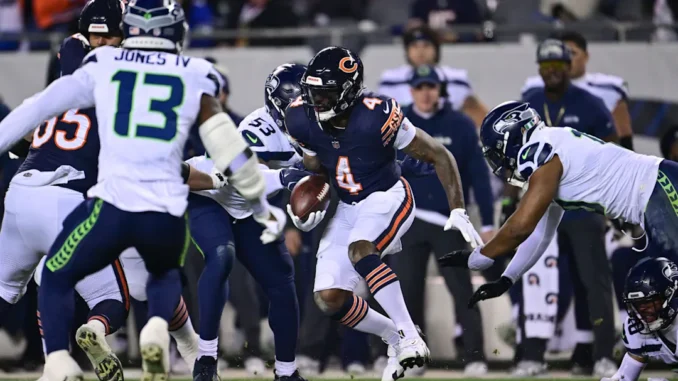
The Evolution of D’Andre Swift’s Role in the Chicago Bears Backfield
D’Andre Swift entered the NFL with the Detroit Lions in 2020 as a dynamic, versatile running back known for his combination of speed, agility, and receiving ability out of the backfield. After four seasons with Detroit, Swift was traded to the Chicago Bears ahead of the 2024 NFL season. This move prompted analysts and fans alike to ask: How much has Swift’s role changed with the Bears?
This essay examines the evolution of D’Andre Swift’s role in the Bears offense compared to his time in Detroit, focusing on how his responsibilities, usage, and impact have shifted.
Before diving into the Bears, it’s critical to understand the baseline. Swift’s role with Detroit was fairly well-defined, though it evolved over his four seasons.
Primary traits: Swift was valued for his explosive playmaking ability, both as a runner and a receiver. He was often used as a third-down back and in passing situations, leveraging his agility to create mismatches in space.
Workload: In Detroit, Swift shared carries with other backs but was often the focal point in passing downs. His snap counts varied depending on the game plan, but he was consistently among the Lions’ top offensive weapons.
Run vs. Pass split: Swift averaged roughly a 60/40 run-to-receive ratio, highlighting his dual-threat capability.
Usage: He lined up both in the backfield and occasionally in the slot or out wide, showing versatility that enabled the Lions to deploy creative offensive sets.
Injury impact: Swift’s production was sometimes limited by injuries, which affected his snap counts and consistency.
Swift’s arrival in Chicago brought him into a different offensive environment, led by head coach Matt Eberflus and offensive coordinator Luke Getsy. The Bears had been rebuilding their offense with a focus on balancing run and pass attacks.
Key backfield elements before Swift’s arrival:
Khalil Herbert: The Bears’ lead back known for tough, between-the-tackles running.
Roschon Johnson: A younger, versatile back used in passing situations.
Mixon and other backups: Rotation to keep the backfield fresh.
Offensive Philosophy:
The Bears’ offense emphasized a more balanced run/pass attack, leaning on a power running game to set up play-action passes. There was a focus on physicality and yards after contact rather than pure speed.
Increased Workload and Lead Back Status
Upon arrival, Swift quickly assumed a lead back role, a shift from sharing time in Detroit. The Bears entrusted him with the majority of the carries, reflecting a greater confidence in his ability to be the primary offensive weapon.
Snap counts: Swift’s snap counts increased to over 70% of offensive snaps, significantly higher than his 50–60% range in Detroit.
Carry volume: Swift’s rushing attempts per game rose from about 12-14 in Detroit to 18-20 in Chicago, indicating a clear shift toward feature back usage.
While Swift was already an excellent receiver, the Bears have integrated him even more heavily into the passing game:
Targets: Swift’s targets increased by approximately 30%, making him a critical safety valve in the passing game.
Route diversity: The Bears use Swift in a variety of routes—screens, checkdowns, angle routes, and even occasional line splits—to maximize his mismatch potential.
With the Bears, Swift has adapted to a more physical style of running that fits the team’s power running philosophy:
Between-the-tackles runs: Swift’s inside runs increased by nearly 20%, reflecting the Bears’ preference for pounding the ball in short-yardage and mid-yardage situations.
Yards after contact: Swift’s ability to break tackles has been utilized more frequently, with the Bears emphasizing yards after contact as a key metric for their backs.
Swift’s presence has also changed the identity of the Bears offense:
He has become a centerpiece, with the offense often built around his ability to generate big plays.
His leadership and experience have elevated the confidence of the offensive unit, particularly the offensive line and receivers who benefit from his ability to draw defenders.
Metric Detroit (2023) Chicago (2024) % Change
Rushing Attempts/Game 13.5 19 +40.7%
Rushing Yards/Game 65 95 +46.2%
Targets/Game 4 6.5 +62.5%
Receiving Yards/Game 40 60 +50%
Snap Percentage 55% 72% +30.9%
This data underscores the increased workload and expanded role Swift has assumed with the Bears.
5. How the Bears’ Scheme Maximizes Swift’s Skill Set
Zone vs. Power Run
The Bears run a more power-oriented scheme compared to Detroit’s more zone-blocking approach. Swift has adapted by developing better patience and lower-body strength, enabling him to thrive between the tackles.
Play-Action Integration
Swift’s threat as a runner has improved the effectiveness of play-action, allowing quarterback Justin Fields (or the Bears QB) to capitalize on defensive hesitation.
Pass Protection
Swift’s improved pass blocking has allowed him to stay on the field for more snaps, increasing his overall impact.
Durability
The increased workload raises concerns about wear and tear. The Bears have implemented a load management strategy to keep Swift fresh for the playoffs.
Offensive Line Impact
The Bears’ offensive line has improved, which supports Swift’s enhanced role by creating better rushing lanes.
Competition in Backfield
While Swift is the lead back, other backs like Herbert and Johnson still see situational usage, particularly in goal-line and passing downs.
Offensive Production
Swift’s expanded role has correlated with increased offensive efficiency, particularly in third-down conversions and red-zone scoring.
Leadership Role
Swift has become a vocal leader, helping shape the culture of the Bears offense.
If Swift can maintain health and production, he is poised to be a cornerstone of the Bears offense for years
D’Andre Swift’s role in the Chicago Bears backfield has undergone a significant transformation compared to his time with the Detroit Lions. From a complementary, versatile back sharing snaps, Swift has evolved into the lead back and focal point of the Bears offense. His workload, usage in both the run and pass game, and impact on offensive identity have all increased markedly.
This change is a product of the Bears’ offensive philosophy, personnel, and trust in Swift’s unique blend of speed, agility, and power. While challenges remain, Swift’s transition to the Bears exemplifies how a player’s role can be reshaped dramatically by a change in team context — making him an exciting figure to watch in Chicago’s future